Immersive Media
Worlds designed for participation
Current manuscript / VNE
How meaning emerges between people,
cultures, and intelligent worlds.
An author and research practice exploring embodied intercultural interaction, immersive media, situated cognition, and relational worldmaking.
VNE is a framework for understanding how meaning is generated through embodied negotiation rather than transferred intact from one person to another. It attends to bodies, cultural histories, timing, gesture, intonation, prosody, gaze, silence, uncertainty, environment, and repair.
Its central unit is not the event or branch. It is the relationship in formation.
The VNE logic
Begin with a modality.
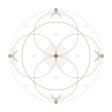
Co-created centre
A provisional centre emerges as participants sense, test, hesitate, adjust, and contribute to a relation neither side owned beforehand.
Gesture, Intonation, Prosody, and Gaze form the primary VNE interaction set. Facial expression can support interpretation but is not treated as universally legible. Mutual Recalibration is not a modality: it is the two-way relational process through which any cue and the emerging shared centre become mutually workable.
Worlds designed for participation
Meaning across difference
Observation in lived settings
Systems that can notice and repair
Writer, immersive narrative designer, researcher, and worldbuilder whose work examines how meaning emerges through bodies, cultures, environments, and intelligent systems. His practice spans animation, cinema, music, immersive media, intercultural collaboration, field research, and relational design.
Founder & CEO / Origatari Inc.
Origatari is the applied platform through which VNE moves from research into immersive worlds, cross-cultural experience design, and intelligent interactive systems.
Origatari conversationsWhy VNE
In 1999, during my first semester at CalArts, an instructor screened a battered Japanese VHS with no subtitles. I knew almost nothing about Japan, and my animation compass still pointed firmly toward Disney. Yet somewhere along the way I stopped asking what the characters were saying and simply entered their world. Years later I learned that the film was My Neighbor Totoro. That small mystery followed me through India, Hollywood, Silicon Valley, and eventually Japan: why could an unfamiliar world feel immediately human, while people in the so-called real world could become almost unintelligible to one another the moment culture, hierarchy, institution, or fear entered the room?
I spent much of my working life moving between systems that were ingenious in their own way and occasionally convinced that their way was the way. Animation, cinema, technology, entrepreneurship, academia, and cross-cultural storytelling taught me extraordinary lessons about invention—and equally memorable lessons about how quickly difference can be mistaken for deficiency. I paid a personal price for some of those failures: lost possibilities, damaged relationships, and a life trajectory that did not go where I had imagined. VNE grew from that collision. It is my attempt to make something useful from the wreckage: to understand how meaning survives difference, to repair what can still be repaired, to recalibrate what I thought I knew, and to find a more honest role for myself in the space between worlds.
Current manuscript
A contemplative and design-oriented account of how meaning emerges through embodied encounters — between people, cultures, places, and increasingly intelligent systems.
Drawing on India, Japan, the United States, and Peru, the book connects performance, situated cognition, immersive media, Buddhist relational thought, and the everyday intelligence of repair.
Robert A. F. Thurman · Alex McDowell · Fred Cummins
Visceral Narrative Environments
How Meaning Emerges Between People,
Cultures, and Intelligent Worlds
VNE / Negotiating Realities
Encounters and observations from ongoing VNE research across Peru, Japan, India, and beyond.
A gesture on a train becomes a shared field of attention before either side can know what the interaction will become.
Open field note →Material memory, skilled adjustment, collective movement.
Bargaining, humour, trust, and skilled adjustment.
Spinning, dyeing, weaving, touch, demonstration, repetition.
A proxemic field note on the space that makes relation possible.
An encounter concerned with gesture, attention, and repair.
The observer enters the world and becomes part of its rhythm.
Public practice
Invited speaker · 2022
Lecture-demonstration · embodied recalibration
Illustrated lecture · workshop · participatory demonstration
Essay on ambiguity and human-centred AI
Relational participation and worldmaking
Trilingual field notes and research essays
Contact
For publishing, speaking, research collaboration, immersive narrative, and intercultural design conversations.
Get in touch